Gold Coast's rapid growth from a fishing village to a major urban centre has reshaped its coastline and hinterland. Early developers often built directly on coastal sands and estuarine clays with minimal geotechnical input. Today, the city's skyline along Surfers Paradise and Broadbeach sits atop Quaternary alluvium and residual soils from the Neranleigh-Fernvale formation. These materials, especially the soft to firm clays beneath the canal estates, demand precise strength characterisation. The unconfined compression test (UCS) provides a fast, reliable measure of undrained shear strength for saturated cohesive soils. It is a core tool for foundation design in Gold Coast's variable ground. Before designing shallow footings, engineers often combine UCS results with a plate load test to validate bearing capacity at specific depths. The test follows AS 1289.6.4.1 and AS 1726-2017, ensuring data that local councils accept for development approvals.
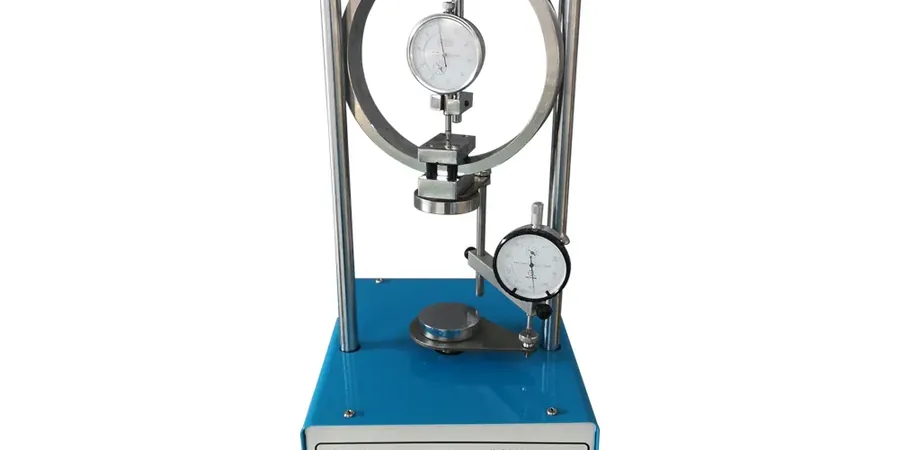
A single UCS test on a Gold Coast estuarine clay can reveal whether the ground can support a two-storey residential slab or requires deep foundations.
Methodology and scope
- Specimen preparation to 2:1 height-to-diameter ratio
- Saturation check and moisture content determination
- Loading until peak or plateau stress
- Calculation of su = σ1/2 for saturated clay
Local considerations
Gold Coast's geology includes soft alluvial clays up to 20 metres thick in the coastal lowlands. These clays are sensitive to disturbance and have low undrained shear strengths, often below 30 kPa near the surface. A key risk is assuming homogeneous strength across a site. In reality, pockets of sandier material or organic layers can create weak zones. The unconfined compression test (UCS) identifies these weak lenses if samples are taken from multiple depths. Without this data, foundations may settle unevenly or fail in bearing. The city's subtropical rainfall also raises the water table close to the surface, reducing effective stress in clay layers. A UCS test on saturated clay gives the most conservative strength estimate, which is critical for temporary excavation support and permanent foundation design.
Applicable standards
AS 1289.6.4.1, AS 1726:2017, ISO 17025 (laboratory accreditation)
Associated technical services
Standard UCS on undisturbed tube samples
Tests on 50 mm or 75 mm diameter tube samples trimmed to 2:1 aspect ratio. Includes moisture content, bulk density, and undrained shear strength. Suitable for clayey soils from the coastal plain and hinterland valleys.
UCS on reconstituted or compacted specimens
For fill materials or compacted clay liners, we prepare specimens at target density and moisture content. Tests follow the same strain rate and failure criteria. Used for quality control in earthworks and landfill liner design.
Multi-depth UCS profiling
A series of UCS tests at 1.5 m intervals from boreholes or test pits. Provides a continuous strength profile for slope stability, excavation support, or foundation design. Results correlated with SPT N-values for a complete soil model.
Typical parameters
Frequently asked questions
What is the difference between UCS and unconsolidated undrained (UU) triaxial test?
UCS applies no confining pressure, while the UU triaxial test applies a confining stress equal to the in-situ overburden. UCS is simpler and faster, but the UU test gives a more realistic strength for clays under load. For Gold Coast's soft estuarine clays, UCS provides a conservative lower bound.
How much does a UCS test cost in Gold Coast?
A standard UCS test on a single undisturbed sample typically ranges from AU$510 to AU$900 depending on sample size, number of moisture determinations, and reporting requirements. Bulk discounts apply for multi-depth profiles from the same borehole.
What sample quality is required for a reliable UCS result?
Samples must be undisturbed, with a minimum 50 mm diameter and length-to-diameter ratio of 2:1. Tube samples must be sealed immediately to prevent moisture loss. Samples showing cracks, large voids, or disturbance are rejected. The laboratory follows AS 1289.6.4.1 for preparation.
Can UCS results be used for all foundation types in Gold Coast?
UCS is primarily for cohesive soils. For sands or mixed soils, it is combined with SPT or CPT data. In Gold Coast's canal estates, UCS works well for soft clays. For stiff clays or residual soils, a UU triaxial or direct shear test may be more appropriate.