On the Gold Coast, the subsurface is mostly soft Holocene clays and silty sands from the Nerang River floodplain and coastal dunes. Preloading with surcharge is a practical method to accelerate consolidation before building roads, embankments, or slabs. We design the fill height, drainage layer, and monitoring schedule based on site-specific consolidation parameters. Before starting, we always cross-check with a stability analysis for cut slopes when adjacent excavations are planned, and we review the bearing capacity of shallow foundations when the preload will later support a structure. Every design follows AS 1726 for site investigation and AS 4678 for earth-retaining structures, with instrumentation like settlement plates and piezometers to verify field behaviour.
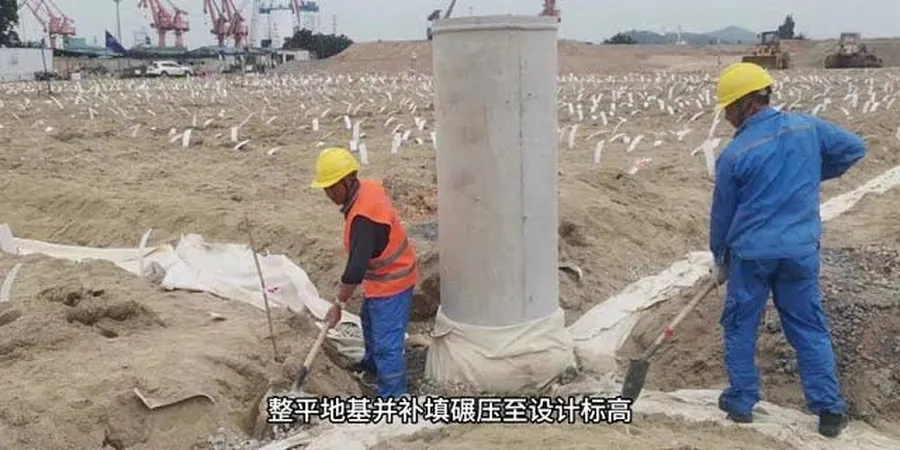
Total settlements of 300–600 mm are typical for Gold Coast soft clays; surcharge accelerates 90% consolidation from years to 3–6 months.
Methodology and scope
- Settlement plates at 20 m grid spacing
- Pneumatic piezometers in each clay sublayer
- Inclinometers if the fill slope exceeds 3 m height
Local considerations
Gold Coast's rapid urban expansion from the 1970s pushed development into low-lying estuarine areas. Many subdivisions were built on compressible clays without adequate preloading, leading to differential settlements of 150–300 mm over 10 years. Roads developed wavy surfaces, and slab-on-ground homes cracked. The city now requires certified preloading designs for any fill > 1.5 m on soft ground. The key risk is underestimating secondary compression (creep) in organic clays, which can continue for decades. Our designs include a creep allowance and a post-construction monitoring plan to catch long-term movement early.
Applicable standards
AS 1726 – Geotechnical Site Investigations, AS 4678 – Earth-Retaining Structures, AS/NZS 1170.0 – Structural Design Actions (general principles)
Associated technical services
Preload Design & Fill Specification
Full design including fill height, staging, drainage blanket, and wick drain layout. We provide a construction specification with compaction density targets and settlement criteria.
Instrumentation & Monitoring
Installation of settlement plates, piezometers, and inclinometers. Weekly data collection and Asaoka analysis to confirm when surcharge can be removed. Reports include settlement-time curves and pore pressure dissipation plots.
Post-Construction Verification
After surcharge removal, we run proof-rolling and plate load tests to verify bearing capacity. We also install long-term survey monuments for 12-month settlement monitoring.
Typical parameters
Frequently asked questions
How long does preloading with surcharge take on the Gold Coast?
For typical 3–5 m clay layers with wick drains, 90% consolidation is achieved in 3–6 months. Without drains, the same clay might take 2–4 years. The exact duration depends on clay thickness, cv value, and surcharge ratio.
What is the typical cost for a preloading design in Gold Coast?
A complete preloading with surcharge design including instrumentation and monitoring for a medium-size site (0.5–1 ha) ranges between AU$1.410 and AU$4.230. Cost varies with clay depth, instrumentation density, and monitoring duration.
Can preloading be combined with wick drains?
Yes. Wick drains are standard when clay thickness exceeds 2 m. They accelerate consolidation by reducing the drainage path from vertical to horizontal. We design the drain spacing (typically 1.0–1.5 m triangular grid) to match the target consolidation time.
What happens if the surcharge is removed too early?
Removing the surcharge before 90% consolidation is reached leaves residual settlement that will occur under the permanent load. This can cause differential movement of road pavements or building slabs. We use field data and Asaoka plots to confirm the right removal time.