Gold Coast's coastal geology presents a distinct challenge for deep foundation design. The city sits on a sequence of Holocene sands and Pleistocene clays, where groundwater sits only a metre or two below the surface in many suburbs. That high water table reduces effective stress in the sand layers, which directly affects the shaft friction component of driven or bored piles. In our experience, the ratio between skin friction and end bearing shifts significantly from Surfers Paradise to the hinterland suburbs, so a single design assumption rarely works across the city. Before selecting a pile type, we typically run a CPT profile to log the tip resistance and sleeve friction continuously, then correlate those values to local databases calibrated for South East Queensland conditions.
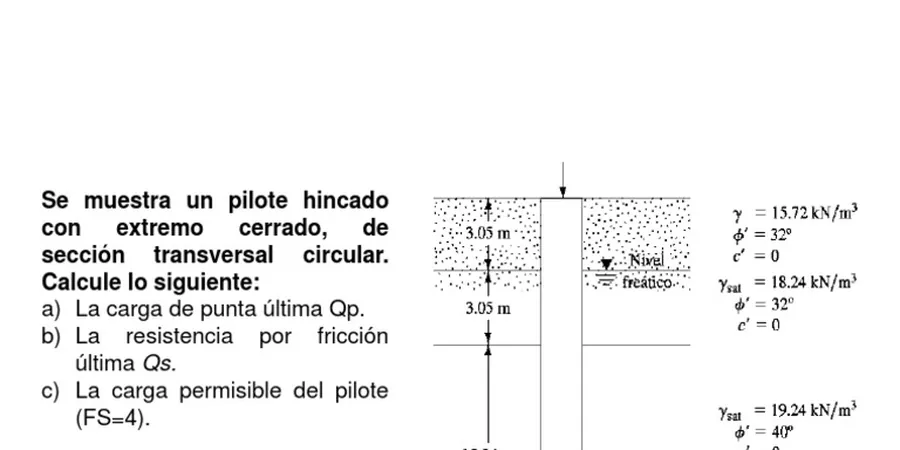
In Gold Coast, the high water table reduces effective stress in sand layers, shifting the balance from skin friction toward end bearing in many coastal suburbs.
Methodology and scope
Local considerations
Comparing the beachfront suburbs with the western suburbs near the Hinterland, the difference in pile behaviour is stark. At Main Beach, loose silty sands produce low shaft friction, so the pile relies heavily on end bearing in the underlying weathered argillite. Over at Robina, the stiff clays can generate high skin friction but also risk negative skin friction if the water table drops during prolonged dry spells. Ignoring that shift can lead to differential settlement between columns. We always run the pile skin friction analysis alongside a check on the cimentaciones-sismicas in zones of moderate seismicity, because cyclic loading can degrade shaft adhesion in saturated sands.
Applicable standards
AS 1726-2017 Geotechnical Site Investigations, AS 4678-2002 Earth Retaining Structures, AS/NZS 1170.4-2007 Structural Design Actions (Earthquake)
Associated technical services
CPT Sounding with Friction Sleeve
Continuous electric cone penetration test measuring tip resistance and sleeve friction every 10 mm. Data processed to separate shaft and base parameters for cohesionless and cohesive layers.
Static Pile Load Test (Maintained Load)
Field test applying axial load to a sacrificial pile while measuring settlement at the head and strain gauges along the shaft. Results are interpreted to isolate skin friction and end bearing components.
PDA / CAPWAP Analysis
High-strain dynamic testing with Pile Driving Analyzer followed by CAPWAP signal matching. Estimates shaft resistance distribution and end bearing capacity for driven piles in Gold Coast sands.
Numerical Back-Analysis (FEM)
Finite element modelling of pile-soil interaction using PLAXIS 2D/3D. Inputs from local CPT and triaxial tests to calibrate the Mohr-Coulomb or hardening soil model for friction and end bearing.
Typical parameters
Frequently asked questions
What is the difference between skin friction and end bearing in pile design?
Skin friction is the shear resistance developed along the pile shaft from the soil-pile interface, while end bearing is the compressive resistance at the pile toe. The dominant mechanism depends on soil layering, pile type, and installation method. In Gold Coast's Holocene sands, skin friction is often limited by the high water table, so end bearing in deeper stiff clays or rock becomes primary.
How much does a pile skin friction vs end bearing analysis cost in Gold Coast?
For a typical residential or commercial project in Gold Coast, the analysis cost ranges between AU$1,740 and AU$4,930. This includes field testing (CPT or PDA), laboratory correlation, and a technical report with skin friction and end bearing profiles. The final cost depends on the number of test locations and pile depth.
Why is the water table so important for pile skin friction in Gold Coast?
A high water table reduces the effective stress in sand layers, which directly lowers the normal stress acting on the pile shaft. Since skin friction in sands is proportional to effective stress, a shallow water table can cut shaft capacity by 30–50% compared to dry conditions. This is why we always measure groundwater depth during CPT or borehole investigations.