Gold Coast's rapid expansion from a small holiday town into a major urban centre has reshaped its geotechnical demands. The city's landscape, a mix of coastal sand barriers, alluvial floodplains, and steep hinterland ridges, presents a challenging canvas for retaining wall design. We have worked on projects from Surfers Paradise basement walls that must resist both lateral earth pressure and groundwater seepage, to terraced residential walls in Tallebudgera Valley cut into residual basalt. Each wall must be tailored to the specific soil profile, drainage regime, and surcharge conditions. Before finalising a retaining wall design, we often integrate a geotechnical site investigation to characterise the subsurface stratigraphy and groundwater levels.
In Gold Coast, the difference between a stable wall and a failure often comes down to how well we characterise the groundwater regime and the residual shear strength of the soil.
Methodology and scope
Local considerations
The subtropical climate of Gold Coast delivers intense summer rainfall events that can saturate the backfill within hours. Inadequate drainage behind a retaining wall is the single most common cause of failure in this region. When pore pressures build up, the effective stress drops, and the lateral force on the wall can double compared to a drained condition. We design all walls with a minimum 300 mm granular drainage blanket, a perforated collector pipe, and a weep-hole system that discharges clear of the toe. We also model extreme events using a 1-in-100-year rainfall intensity and check the wall for both static and pseudo-static seismic loads under AS 1170.4, because Gold Coast sits in a moderate seismic zone.
Applicable standards
AS 4678-2002: Earth-retaining structures, AS 1726-2017: Geotechnical site investigations, AS 1170.4-2007 (R2018): Earthquake actions, AS 3600-2018: Concrete structures (for reinforced concrete walls)
Associated technical services
Cantilever and Gravity Wall Design
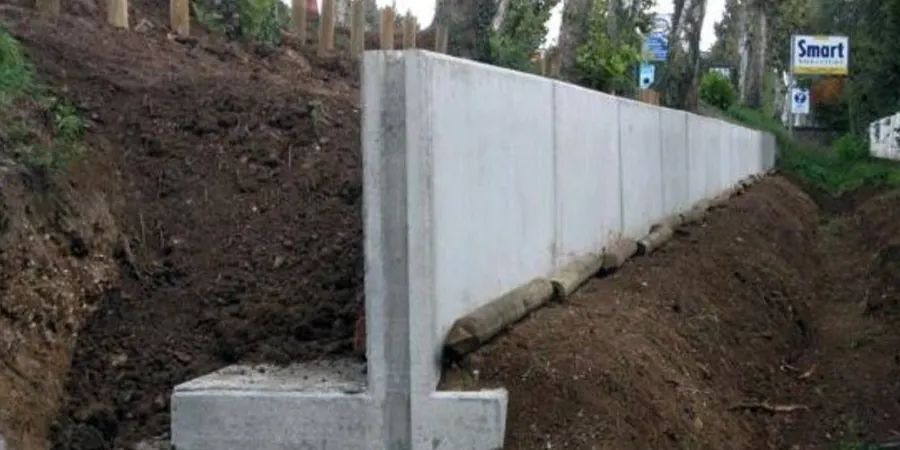
Reinforced concrete cantilever walls for heights up to 3 m, and gravity walls using mass concrete or modular blocks for lower heights. We provide detailed reinforcement schedules, stability checks against overturning and sliding, and bearing pressure verification.
Anchored and Tie-Back Wall Design
For walls taller than 3 m or where space is limited, we design anchored walls using ground anchors or soil nails. Each anchor is tested to 1.5 times the design load, and we verify bond length against the local soil shear strength.
Segmental Retaining Wall (SRW) Design
Design of modular block walls with geogrid reinforcement, commonly used in residential subdivisions. We calculate the required reinforcement length and vertical spacing based on the soil friction angle and the wall's geometry.
Drainage and Waterproofing Strategy
We design the complete drainage system behind every wall: granular drainage layer, collector pipe, weep holes, and a waterproof membrane on the soil side. This prevents hydrostatic pressure build-up and extends the wall's service life.
Typical parameters
Frequently asked questions
What is the typical cost range for a retaining wall design in Gold Coast?
For a standard residential wall up to 3 m in height, the design fee including site visit, soil parameter derivation, and structural drawings ranges between AU$1,860 and AU$6,910. Larger or more complex walls with anchors or seismic checks will be at the upper end of that range.
How deep do I need to excavate for a retaining wall footing in Gold Coast?
The footing depth depends on the soil bearing capacity and the wall height. In coastal sands, we typically specify a minimum 600 mm embedment below the finished ground level, while in residual clays we may go to 900 mm to reach a consistent bearing stratum. Frost depth is not a concern here, but scour and groundwater level are.
Do I need a geotechnical report before designing a retaining wall?
Yes, absolutely. AS 4678 requires that the designer have site-specific soil parameters. Without a geotechnical report, you risk under-designing the wall or, worse, over-designing it and wasting money. We can arrange the investigation as part of our service, including boreholes or test pits, SPT, and laboratory testing.
Can I build a retaining wall on a sloping block in Tallebudgera Valley?
Yes, but the design must account for the slope stability of the hillside above and below the wall. We perform a slope stability analysis using Bishop's method to ensure the global factor of safety is at least 1.5 under static conditions. The wall itself must be designed to resist the additional lateral load from the sloping backfill.