Gold Coast sits on a mix of coastal dune sands and estuarine clays from the Nerang River system. The water table sits high, often within a meter of the surface. That combination makes road embankment design a careful balancing act. We have to account for settlement under self-weight and traffic loads. A standard fill placed without proper testing will sink unevenly. Our lab runs compaction trials and CBR tests to match the borrow material to the site conditions. We also check the subgrade strength with plate load tests to confirm the foundation can carry the embankment without failure.
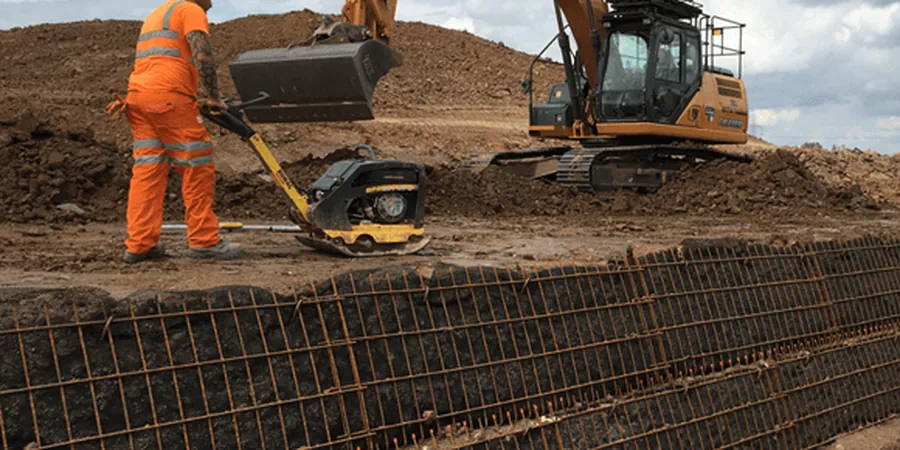
Embankments on Gold Coast's soft clays require staged construction and drainage to control settlement and maintain slope stability.
Methodology and scope
Local considerations
Gold Coast gets over 1,200 mm of rain a year, and the water table can rise rapidly. That raises the risk of embankment saturation and slope failure. A fill built without proper drainage will soften and may slide during a storm event. We assess seepage paths using field permeability tests and install horizontal drains where needed. The 2011 flood event showed how quickly embankments can erode when not designed for extreme rainfall. Our road embankment design accounts for those conditions to keep the fill stable and the road open.
Applicable standards
AS 1726:2017 Geotechnical site investigations, AS 4678:2002 Earth-retaining structures, AS/NZS 1170.0:2002 Structural design actions, Austroads Guide to Pavement Technology Part 4C
Associated technical services
Compaction control testing
Field density tests using nuclear gauge or sand cone, plus lab Proctor curves to set target moisture and density for each lift.
Subgrade strength evaluation
In-situ CBR, DCP, and plate load tests to verify the foundation can support the embankment loads without excessive settlement.
Slope stability analysis
Limit equilibrium models using Bishop and Spencer methods to check factors of safety under static and seismic conditions.
Drainage and erosion control design
Design of drainage layers, blanket drains, and erosion protection using geotextiles or rock riprap to manage stormwater.
Typical parameters
Frequently asked questions
How does road embankment design differ between coastal sands and inland clays in Gold Coast?
Coastal sands compact easily and drain well, so settlement is minimal. Inland clays have high plasticity and low permeability. They require staged construction and wick drains to control pore pressure. We adjust the compaction specs and drainage design based on the specific soil type at each site.
What is the typical cost range for road embankment design in Gold Coast?
The typical cost for geotechnical input into road embankment design ranges from AU$1,960 to AU$7,250 depending on the fill height, soil variability, and testing volume. That includes site investigation, lab testing, and the design report.
Why is drainage so important for Gold Coast embankments?
Gold Coast has a subtropical climate with heavy summer storms. Without drainage, water builds up inside the fill and reduces shear strength. That can cause slope failure or differential settlement. We always include drainage layers and outlet pipes in the design.
How long does a road embankment design study take?
A typical study takes two to four weeks from initial site visit to final report. That includes boreholes or test pits, lab testing (Proctor, CBR, triaxial), and stability modeling. Fast-track options are available for urgent projects.