On site, the geocell rolls are delivered as compact honeycomb panels. Our crew unfolds each section on the prepared subgrade, stretching the cells into a three-dimensional mattress. A spreader beam then lifts the panel into position while we pin the edges with steel U-stakes. The entire operation moves fast once the area is graded. For Gold Coast projects, the cellular confinement system is particularly valuable on sandy fills and soft estuarine clays. Before laying geocells, we always verify the subgrade bearing capacity with a plate load test. The plate load test confirms whether the ground can support the design loads without excessive settlement. After that, we infill the cells with granular material – typically crushed rock or site-won sand – and compact in layers. The result is a stiffened composite layer that distributes loads laterally, reducing rutting and deformation on access roads, parking areas, and embankments across the Gold Coast.
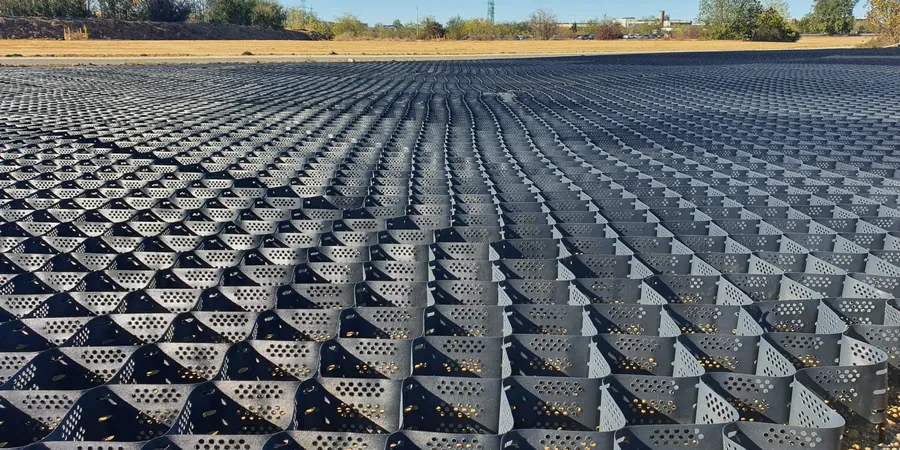
Geocell design on Gold Coast’s sandy fills requires verifying subgrade bearing capacity before infill to prevent differential settlement under traffic loads.
Methodology and scope
Local considerations
Gold Coast’s subtropical climate brings intense summer storms and a high water table. That moisture can soften the subgrade beneath a geocell layer if the system isn’t properly drained. The biggest risk we see is hydrostatic pressure building up under the panel during a heavy downpour, which can lift the entire mattress. Another common issue is differential settlement when the geocell is laid over variable fill thicknesses without a proper geotechnical investigation. To avoid these problems, we always install a drainage blanket or perforated pipes at the base and design the cell infill to allow free water movement. For Gold Coast sites near canals or the coast, we also check the local groundwater level and the potential for tidal fluctuations that could affect the anchorage.
Explanatory video
Applicable standards
AS 4678-2002: Earth-retaining structures, AS 1726-2017: Geotechnical site investigations, AS/NZS 1170.0:2002: Structural design actions – general principles
Associated technical services
Geocell Base Reinforcement for Access Roads and Hardstands
Design and installation of geocell mattresses under unpaved roads, laydown yards, and crane pads. Includes subgrade evaluation, panel selection, infill specification, and compaction control. Ideal for sandy coastal soils and reclaimed land.
Geocell Slope and Embankment Protection
Reinforced geocell systems for steep slopes, canal banks, and fill embankments. Combines cellular confinement with vegetation or rock infill for erosion control and slope stability. Designed per AS 4678 with drainage integration.
Typical parameters
Frequently asked questions
What is the typical cost range for a geocell design and install project on the Gold Coast?
For a standard access road or hardstand, expect a total installed cost between AU$1.240 and AU$4.280 per square metre, depending on panel height, infill material, and site access. Larger volumes reduce the unit rate.
How does geocell design differ for Gold Coast’s sandy soils versus clay subgrades?
On sandy soils, the main challenge is loss of infill through the open cells – we specify a geotextile separator and a finer infill fraction. On clay subgrades, the risk is water softening, so we add a drainage layer and use perforated cells to relieve pore pressure.
Can geocells be used on slopes steeper than 1V:1.5H?
Yes, but the design must include a toe anchor system and a higher-strength polymer grade. We also check the global stability of the slope using limit equilibrium methods per AS 4678. For Gold Coast’s canal banks, we typically limit slopes to 1V:1.5H unless additional reinforcement is provided.
What is the design life of a geocell system under permanent loading?
A properly designed and installed geocell system with UV-stabilised HDPE panels has a design life of 50 years for permanent works. The infill material and drainage system must be maintained to avoid long-term settlement or clogging.