The subsurface profile beneath Broadbeach differs markedly from that around Burleigh Heads – the former showing deep sequences of Holocene beach sand and estuarine deposits, while the latter sits on weathered rhyolite and colluvium. In both settings, the SPT (Standard Penetration Test) remains our primary tool for obtaining reliable N-values at depth, guiding foundation decisions under AS 1726. We routinely run SPT borings to 25 m in the coastal strip, where loose sands require careful correction for overburden before assessing bearing capacity. For shallow foundations on the rocky western suburbs, N-values above 50 are common, but the test still provides essential data on refusal and layer transitions. Combining SPT results with MASW-Vs30 surveys helps us correlate blow counts with shear-wave velocity for seismic site classification – a step increasingly required on the Gold Coast as development intensifies on reclaimed land.
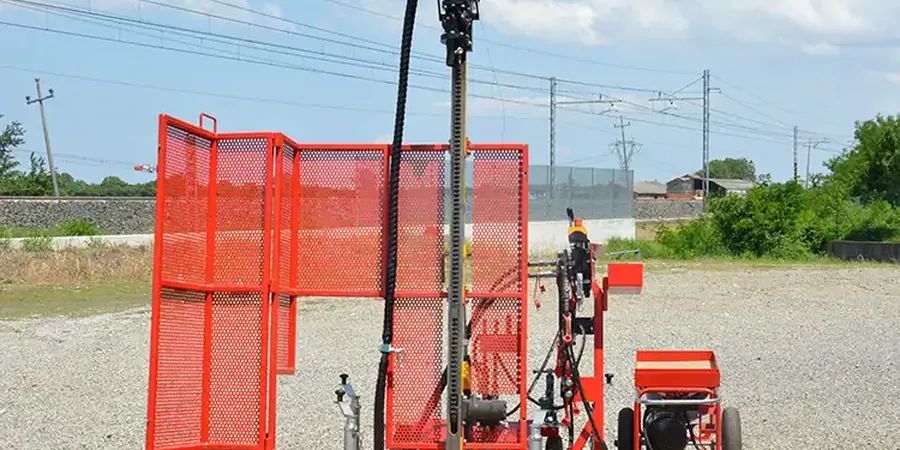
A consistent energy ratio above 75% on our automatic hammers ensures that N-values from Gold Coast borings are repeatable and directly comparable with published correlations.
Methodology and scope
Local considerations
AS 1726 requires that SPT N-values be corrected for energy efficiency before use in liquefaction assessment, yet many local reports still rely on uncorrected blow counts from old safety hammers. On the Gold Coast, where loose to medium-dense sands underlie much of the coastal strip, uncorrected N-values can overestimate density by 15–25%, leading to unconservative foundation designs. The risk is highest in areas like Surfers Paradise and Main Beach, where the water table sits within 2 m of the surface. Under Youd and Idriss (2001) criteria, cyclic resistance ratio (CRR) curves are calibrated to an energy ratio of 60%, so our N60 values are routinely reported. Without this correction, a site classified as non-liquefiable under the raw N-value could actually be marginal during a magnitude 7.0 event. Our reports always include energy-corrected N60 together with fines-content adjustments, giving the structural engineer a defensible basis for foundation design under AS/NZS 1170.0.
Applicable standards
AS 1289.6.3.1 – Standard Test Method for SPT, AS 1726:2017 – Geotechnical Site Investigations, AS 4678:2002 – Earth Retaining Structures, NCEER 1997 – SPT-based liquefaction evaluation procedures
Associated technical services
Standard SPT Borings with Field Logging
Continuous SPT sampling at 1.5 m intervals or as specified, with full field logs including soil description, moisture content, and recovery ratios. Suitable for residential, commercial, and infrastructure projects across the Gold Coast.
Energy- and Overburden-Corrected N-Values (N60, N1,60)
All blow counts corrected for hammer energy (ERi), rod length, borehole diameter, and effective overburden stress. Essential for liquefaction assessment and bearing capacity calculations under AS 1726.
Liquefaction Susceptibility Screening
SPT-based liquefaction evaluation using the NCEER/Youd-Idriss method, including fines-content correction and cyclic stress ratio (CSR) calculation. Critical for sites near the Nerang River, Broadwater, and canal estates.
Typical parameters
Frequently asked questions
How much does an SPT test cost in Gold Coast?
A standard SPT boring to 15 m depth with continuous sampling typically falls between AU$850 and AU$1,210 per borehole, including mobilisation within the Gold Coast area. The final cost depends on site access, number of borings, and whether additional laboratory testing is required. Contact us for a site-specific quotation.
What is the difference between N-value and N60?
The raw N-value is the blow count recorded in the field without any corrections. N60 is the blow count normalised to a hammer energy efficiency of 60%, removing the variation between different hammer types. AS 1726 and most liquefaction correlations (Youd and Idriss 2001) require N60 for consistent interpretation. Our reports always present both values.
Do I need SPT testing for a house slab on Gold Coast sand?
For a single-storey slab on loose to medium-dense coastal sand, SPT borings to 6–8 m depth are recommended. The N-values help classify the sand as loose (N < 10), medium dense (N 10–30), or dense (N > 30), which directly affects the allowable bearing pressure and the need for ground improvement. We often combine SPT with a plate load test for verification.
What corrections should be applied to SPT results in Gold Coast?
For Gold Coast sands, the essential corrections are: energy efficiency (to N60), overburden stress (CN), and fines content adjustment for liquefaction. Rod length and borehole diameter corrections are also applied per AS 1289.6.3.1 and AS 1726. Without these, raw N-values can overestimate density by 15–25% in the loose sands typical of coastal areas.