Stone column design in Gold Coast must follow the requirements of AS 1726-2017 for site investigation and AS 4678-2002 for earth retaining structures, given the city's widespread Quaternary alluvial deposits. The coastal geology — Holocene sands, estuarine silts, and compressible clays — creates ideal conditions for vibro-replacement techniques. A thorough geotechnical model combining CPTu soundings and SPT profiles is essential before sizing stone columns, since variable groundwater levels between 1.5 and 4 m depth directly influence column installation and performance. For sites requiring additional lateral confinement, integrating stone columns with geoceldas can further improve load distribution and slope stability.
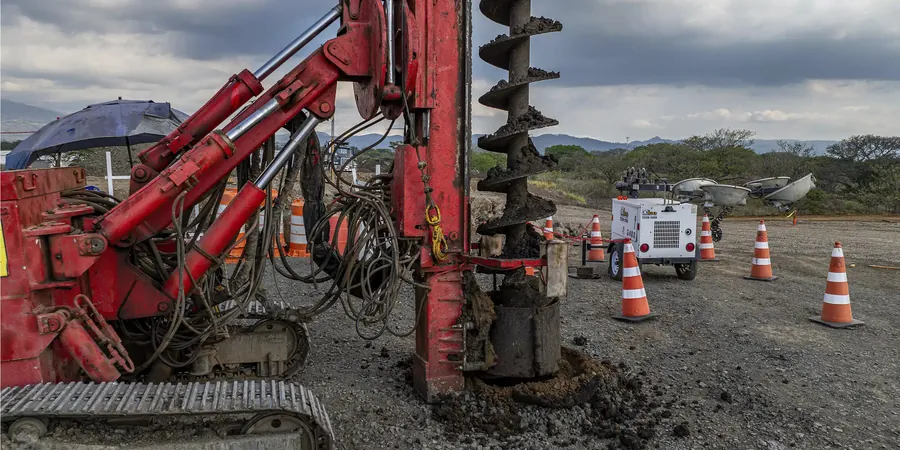
Area replacement ratios of 15–35% and column diameters up to 1.2 m are typical for Gold Coast's soft alluvial soils, reducing total settlements by 50–70%.
Methodology and scope
- Column diameter: 0.6–1.2 m depending on vibroflot power
- Area replacement ratio: 15–35% for typical loading
- Maximum column depth: 18 m limited by vibroflot reach
- Installed gravel gradation: 20–50 mm crushed stone
Local considerations
Gold Coast's coastal geology presents two primary risks for stone column projects: liquefaction potential in loose saturated sands and excessive total settlements in soft estuarine clays. The region's seismic hazard, classified as AS 1170.4 Zone B, demands careful evaluation of cyclic softening and lateral spreading. Groundwater levels fluctuate seasonally between 1.5 and 4 m depth, which can affect column installation quality and long-term drainage performance. A common failure mode is inadequate lateral confinement in very soft clays (Su < 15 kPa), requiring a sand blanket or surcharge prior to column installation. The combination of vibro-replacement with geotextiles as basal reinforcement can mitigate these risks.
Applicable standards
AS 1726-2017 — Geotechnical site investigations, AS 4678-2002 — Earth retaining structures, AS/NZS 1170.4:2011 — Structural design actions (seismic)
Associated technical services
Stone Column Feasibility Study
Geotechnical review and numerical modeling to determine column geometry, spacing, and area replacement ratio based on site-specific CPTu and SPT data.
Vibro-Replacement Design
Detailed design using Priebe and finite element methods, including column layout optimization, settlement analysis, and liquefaction mitigation assessment.
Installation QA/QC & Verification
On-site supervision, amperage monitoring during installation, and post-construction plate load tests or column integrity testing to confirm design assumptions.
Typical parameters
Frequently asked questions
What is the typical cost range for stone column design on the Gold Coast?
For a standard residential or commercial project, stone column design and installation costs range between AU$2.340 and AU$8.910, depending on column depth, grid density, and site access conditions. This covers geotechnical interpretation, numerical modeling, and construction-phase QA.
How long does a stone column design project typically take?
A typical design phase takes 2 to 4 weeks from receipt of site investigation data. This includes parameter interpretation, column layout optimization, and settlement predictions. Larger projects with variable stratigraphy may require additional modeling time.
What soil conditions are unsuitable for stone columns?
Stone columns are not effective in highly organic soils, peats, or soils with undrained shear strength below 10 kPa without pre-treatment. Excessively dense gravelly soils also limit vibroflot penetration. In such cases, alternative ground improvement methods like preloading or deep mixing are recommended.