Anyone who has worked on a site in Gold Coast knows the ground can change dramatically within a single block. One moment you are in clean beach sand, the next you hit a layer of stiff clay from an old floodplain. That is why pile foundation design here is never a one-size-fits-all exercise. The water table sits high in most suburbs, and the coastal sands lack the cohesion needed for shallow footings. We start every project with a targeted site investigation, typically combining SPT borings with CPT soundings to map the soil profile. For high-rise projects along Surfers Paradise, we often recommend driven precast piles socketed into the underlying Neranleigh-Fernvale meta-sediments. For low-rise residential work, screw piles or CFA piles offer a quieter, lower-vibration alternative. Before specifying any pile type, we run a granulometry to understand grading and a triaxial test to measure drained shear strength. This data feeds directly into our geotechnical design reports, which reference AS 2159 for structural load limits and AS 1726 for soil classification.
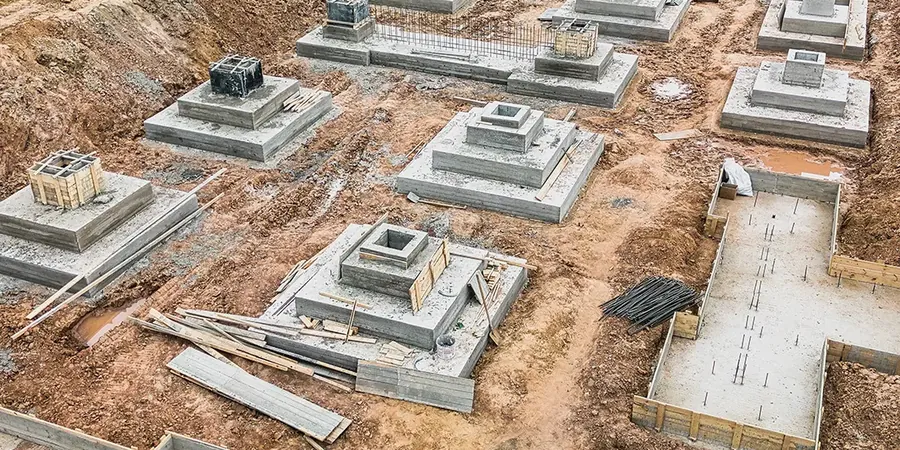
In Gold Coast sands, shaft friction in the top 5 metres is negligible. End-bearing on the meta-sediments is what carries the load.
Methodology and scope
Local considerations
Gold Coast sits on a coastal plain underlain by Quaternary sands, with the bedrock surface dipping steeply towards the coast. The 2011 Brisbane floods and the 2019 bushfire season reminded everyone how quickly surface conditions can change, but the real geotechnical risk lies underground. Loose sand layers less than 5 metres deep can liquefy during a magnitude 6.5 earthquake, which has a 10% probability of exceedance in 50 years according to AS 1170.4. If the pile foundation design ignores this, the structure could experience differential settlement or lateral spreading. We always check the factor of safety against liquefaction using SPT blow counts and CPT soil behaviour type. If the factor is below 1.1, we either extend piles through the liquefiable layer into competent strata or recommend ground improvement such as stone columns to densify the sand.
Applicable standards
AS 2159-2009: Piling – Design and Installation, AS 1726-2017: Geotechnical Site Investigations, AS/NZS 1170.4: Earthquake Actions (site class determination), AS 3600: Concrete Structures (for pile cap design), NATA accreditation for laboratory testing (ISO/IEC 17025)
Associated technical services
Driven Precast Pile Design
Design of square or octagonal precast piles driven to the meta-sediment layer. Includes wave equation analysis to select hammer size and cushion material. We verify capacity with PDA testing and CAPWAP signal matching. Typical working loads range from 800 kN to 2000 kN per pile.
CFA and Screw Pile Design
For sites where noise or vibration is a concern, we design continuous flight auger (CFA) or helical screw piles. These are torque-monitored during installation, providing real-time verification of soil resistance. Suitable for loads up to 600 kN per pile in Gold Coast sands.
Lateral and Uplift Pile Analysis
For structures subject to wind loads (cyclone region D per AS/NZS 1170.2) or seismic action, we design piles to resist lateral forces and uplift. We use p-y curve analysis to model soil-pile interaction and check group effects. Includes design of pile caps and tie beams.
Typical parameters
Frequently asked questions
What is the typical cost of a pile foundation design in Gold Coast?
For a standard residential project with 6 to 12 piles, the geotechnical design fee ranges from AU$2.850 to AU$4.500. For larger commercial projects with 50+ piles and PDA testing, the fee can reach AU$9.530. These figures include site investigation, laboratory testing, and the certified design report. Actual costs vary based on site access, soil variability, and the number of test piles.
How deep do piles need to go in Gold Coast?
Depths vary significantly. In Surfers Paradise and Broadbeach, piles typically reach 12 to 18 metres to socket into the meta-sediment rock. In the northern suburbs like Helensvale or Coomera, where the rock is shallower, piles may stop at 6 to 10 metres. We determine the exact depth using SPT N-values and CPT cone resistance, targeting a minimum end-bearing capacity of 5 MPa.
Do I need a pile foundation or can I use a shallow footing?
That depends on the soil bearing capacity at your site. Gold Coast's coastal sands typically have an allowable bearing capacity of 50 to 100 kPa, which is insufficient for multi-storey structures. A shallow footing might work for a single-storey house on compact dune sand, but most residential slabs require at least 150 kPa. We recommend a site investigation first to confirm. If the bearing capacity is below 100 kPa at 1.5 metres depth, piles are the safer option.
What is the difference between a Type 1 and Type 3 pile design?
Under AS 2159, Type 1 relies entirely on static analysis without load testing. It is the cheapest but least reliable for variable ground. Type 3 requires a static load test on at least one pile to confirm capacity. Most Gold Coast projects use Type 2, which combines static analysis with dynamic testing (PDA) on 5 to 10% of piles. Type 3 is reserved for critical structures like hospitals or high-rise towers where failure is not an option.