Between the coastal sands of Surfers Paradise and the alluvial clays of the Hinterland, the subsurface conditions on the Gold Coast vary dramatically. In Broadbeach we often find loose beach sands over stiff clay, while near the Nerang River we encounter soft estuarine deposits that require deep ground improvement before any reinforced soil structure. For MSE walls on these soft soils, we typically specify geogrid lengths of 0.7H to 0.8H and check internal stability against pullout using the coherent gravity method per AS 4678. A proper geotechnical investigation is critical to define the peak friction angle and interface shear parameters for design.
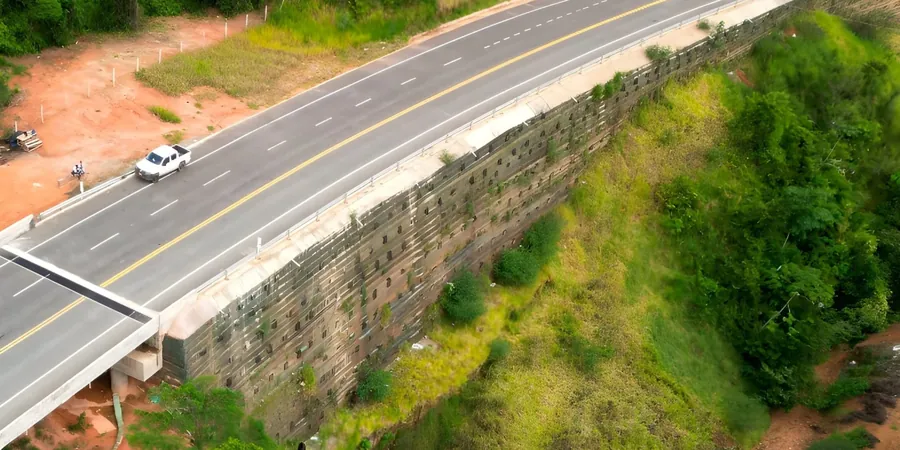
For MSE walls on Gold Coast soft clays, we limit the reinforcement vertical spacing to 0.4 m and use a minimum pullout safety factor of 1.5 per AS 4678.
Methodology and scope
- Reinforcement pullout resistance computed at each layer using the Meyerhof-type distribution
- Bearing capacity checks for the foundation soil using Terzaghi's equation modified for eccentric loading
- Settlement estimates using the Schmertmann method for granular fills and the Casagrande method for clay foundations
Local considerations
A recent 8 m high MSE wall on a residential development near Helensvale experienced 120 mm of settlement during construction because the foundation clay was treated as medium stiff when it was actually soft with an undrained shear strength of 25 kPa. We had to stop the wall construction, install vertical drains, and apply a 3 m surcharge fill for 6 weeks. That is why we insist on undisturbed sampling with thin-wall tubes and triaxial testing (UU and CU) on every Gold Coast project involving cohesive foundation soils. The cost of a proper site investigation is negligible compared to a wall failure or remedial works.
Applicable standards
AS 4678:2002 - Earth-retaining structures, AS 1726:2017 - Geotechnical site investigations, AS/NZS 1170.2:2021 - Structural design actions (wind loads), FHWA-NHI-10-024 - Design and construction of mechanically stabilized earth walls
Associated technical services
Reinforcement layout and design
Selection of geogrid type (uniaxial vs biaxial), length, and vertical spacing based on internal and external stability requirements per AS 4678. We compute pullout resistance using the interface shear parameters from direct shear tests on the actual backfill.
Drainage and facing design
Design of chimney drains, drainage blankets, and weep holes to prevent hydrostatic pressure build-up. Facing options include segmental blocks, wrap-around, or full-height panels, with detailing for seismic zones according to AS/NZS 1170.4.
Construction quality assurance (CQA)
On-site verification of reinforcement placement, backfill compaction (modified Proctor at 95% MDD), and drainage layer installation. We provide weekly CQA reports with photographic evidence and field density test results.
Typical parameters
Frequently asked questions
What is the typical cost range for MSE wall design on the Gold Coast?
For a complete design package including reinforcement layout, stability analysis, and CQA documentation, expect between AU$1.830 and AU$6.890 depending on wall height, number of tiers, and foundation conditions. This covers all calculations, drawings, and site inspections during construction.
What reinforcement type is recommended for Gold Coast marine clays?
For soft marine clays with undrained shear strength below 30 kPa, we recommend uniaxial geogrids with a long-term design strength of at least 80 kN/m. The reinforcement length must be increased by 20% compared to standard designs to compensate for low pullout resistance in cohesive soils. We also specify a geotextile separation layer between the clay and the granular backfill.
How do you check seismic stability for MSE walls in Gold Coast?
Gold Coast is classified as seismic zone 0 (AS 1170.4), but we still perform a pseudo-static analysis using a horizontal seismic coefficient of 0.05g for important structures. The Mononobe-Okabe method is used to compute dynamic earth pressures, and we check that the reinforcement pullout safety factor remains above 1.3 under seismic loading. For tiered walls taller than 6 m, we also run a displacement-based analysis using the Newmark sliding block method.
Can MSE walls be built on fill material from the site?
Yes, but the fill must meet strict criteria: less than 5% passing the 0.075 mm sieve, plasticity index below 6, and a friction angle of at least 32 degrees from drained triaxial testing. We often test on-site fill from the Gold Coast hinterland (weathered rhyolite), which typically meets these requirements after crushing and screening. Imported sand from the coastal dunes is also suitable but requires compaction at OMC ± 2% to achieve 95% MDD.