Gold Coast sits on deep Quaternary alluvial deposits, a setting where AS 1726-2017 and the National Construction Code Series require site-specific seismic classification. Without proper microzonation, the variability in soil stiffness across the city's coastal plain can lead to incorrect design spectra. We combine MASW surveys with standard penetration tests to map shear-wave velocity profiles down to 30 meters. This data feeds directly into the site class assignment under AS/NZS 1170.4. For projects on reclaimed land near the Broadwater, we also integrate cimentaciones sísmicas to verify that foundation design accounts for local amplification effects.
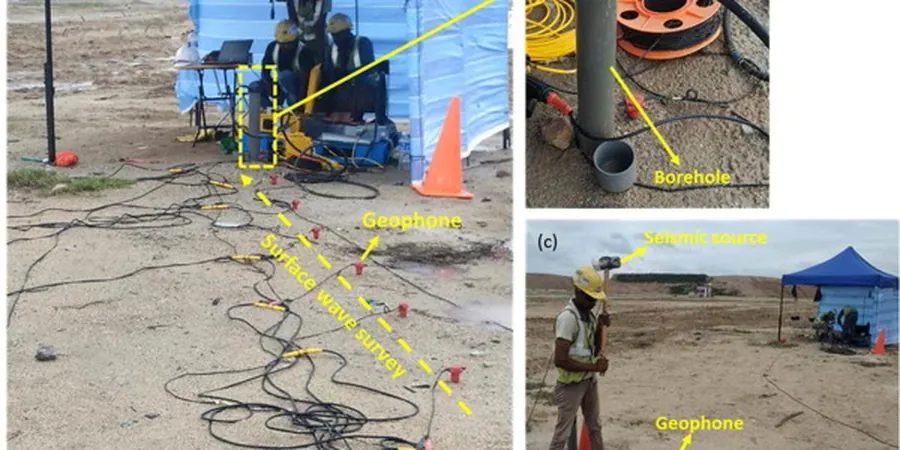
Gold Coast's soil variability over short distances makes site-specific microzonation essential for safe and economical seismic design.
Methodology and scope
Local considerations
A common mistake is treating Gold Coast as a single seismic zone. Developers often use a generic site class D for the entire Gold Coast region. This ignores the stiff sand ridges in the north that behave as site class C, or the soft estuarine clays in the south that can amplify shaking by a factor of two. Without microzonation, a building on competent sand gets over-designed, wasting material, while one on soft clay may be under-designed, risking damage during an earthquake. The result is either inflated costs or unsafe structures.
Applicable standards
AS 1726-2017 Geotechnical Site Investigations, AS/NZS 1170.4:2007 Structural Design Actions — Earthquake actions, AS 1289/D4428M-14 Standard Test Methods for Crosshole Seismic Testing, NCEER (Youd & Idriss 2001) Liquefaction Evaluation Procedure
Associated technical services
Geophysical Microzonation
MASW and refraction microtremor surveys to map VS30 at 50 m grid spacing. Output includes site class maps and 1D amplification functions. Ideal for master planning and large subdivisions.
Geotechnical Microzonation
Boreholes with SPT and undisturbed sampling at critical points. Combined with CPT soundings for liquefaction assessment. Produces zone-specific design parameters for each foundation layer.
Typical parameters
Frequently asked questions
What is seismic microzonation and why is it needed in Gold Coast?
Seismic microzonation divides a region into zones with distinct earthquake ground response characteristics. Gold Coast's soil varies from dense sands to soft clays over short distances, so using a single site class leads to inaccurate design. Microzonation provides site-specific amplification factors and liquefaction hazard maps.
How much does a seismic microzonation study cost in Gold Coast?
The typical cost ranges from AU$7,290 to AU$27,320 depending on the area coverage, number of test points, and whether geophysical surveys are included. A small residential block may fall at the lower end, while a large development requiring multiple MASW lines and boreholes reaches the upper range.
What is the difference between site class and microzonation?
Site class (A to E per AS/NZS 1170.4) assigns a single category to a property based on average VS30. Microzonation goes further: it creates a map showing how site class changes across a precinct, and it quantifies amplification factors for each zone, including basin-edge effects common in Gold Coast's buried valleys.
How long does a microzonation study take?
A typical study takes 4 to 8 weeks from field work to final report. Geophysical surveys (MASW) are completed in 2–3 days, followed by boreholes and CPT soundings. Laboratory testing and numerical modeling of site response add 2–3 weeks. Urgent projects can be expedited to 3 weeks.