Gold Coast's coastal geology is dominated by thick Holocene sands and soft estuarine clays, often with groundwater less than 2 metres below surface. These saturated, compressible layers are exactly where prefabricated vertical drain (PVD) design becomes critical for accelerating consolidation under fill or structural loads. Without proper spacing and depth calculations, settlement timelines can stretch from months to years. We combine local soil data from site investigations — including the ensayo CPT for continuous profiling — with consolidation theory to deliver PVD layouts that actually match the ground conditions in Gold Coast.
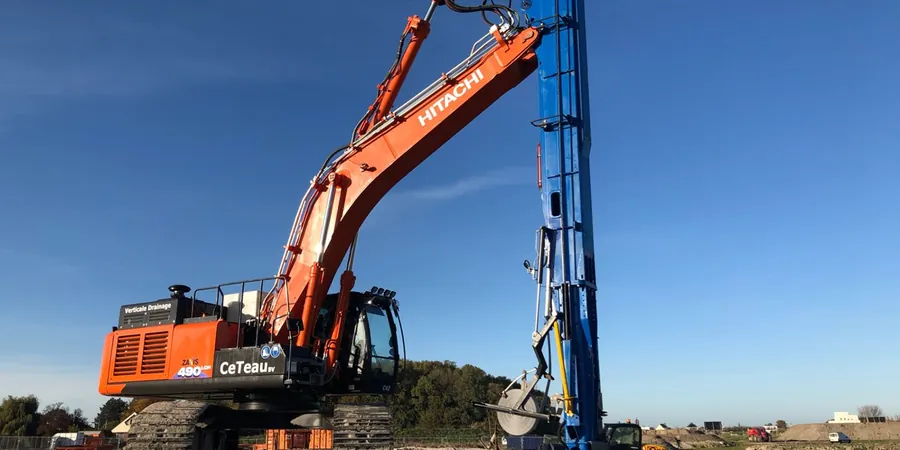
PVD spacing in Gold Coast clays typically ranges from 1.2 to 2.5 metres, depending on clay thickness and fill schedule.
Methodology and scope
- Smear zone estimation based on mandrel geometry
- Time-rate analysis using Asaoka or Barron's method
- Spacing optimisation for staged construction
Local considerations
In Gold Coast, we often see PVD installations where the drains were too widely spaced for the actual clay compressibility, leading to residual settlement after handover. The risk is not just delays — it is structural damage to road pavements, building slabs, and buried services. A prefabricated vertical drain design that ignores local consolidation rates or assumes ideal drainage conditions will fail to control post-construction settlement. We have seen two-storey residential projects in Varsity Lakes where differential settlement cracked internal walls because the PVD spacing was based on a generic chart, not on site-specific parameters.
Applicable standards
AS 1726 – Geotechnical site investigations, AS 4678 – Earth retaining structures, AS/NZS 1170.0 – Structural design actions (fill loads)
Associated technical services
Site investigation & soil profiling
CPT, boreholes and undisturbed sampling to map clay layers and measure consolidation parameters specific to your site.
PVD spacing & depth design
Analytical design using Barron's radial consolidation theory, calibrated with local cv and kh data.
Settlement monitoring plan
Instrumentation design including settlement plates and piezometers to verify PVD performance during fill placement.
Staged construction sequencing
Timeline optimisation for fill lifts, wait periods, and surcharge removal based on predicted degree of consolidation.
Typical parameters
Frequently asked questions
What is the typical PVD spacing for Gold Coast clay sites?
For most Gold Coast soft clay deposits, we design PVD spacing between 1.2 and 2.5 metres in a square grid. The exact spacing depends on clay thickness, required degree of consolidation, and fill construction schedule.
How long does consolidation take with PVDs in Gold Coast?
Achieving 90% consolidation typically takes 3 to 12 months, depending on clay permeability and drain spacing. Thicker clay layers near the Broadwater can require the upper end of that range.
Do I need a geotechnical investigation before PVD design?
Absolutely. Without CPT or borehole data showing clay type, thickness, and consolidation coefficient, any PVD design is guesswork. We always recommend at least three CPT soundings per site to capture variability.
What is the cost range for a PVD design service in Gold Coast?
A complete prefabricated vertical drain design package — including site investigation, analysis, and spacing drawings — typically ranges from AU$1,450 to AU$3,770 depending on site size and complexity.