Gold Coast sits on a mix of coastal sands, estuarine silts, and reclaimed lowlands, with over 600,000 residents and one of Australia's fastest-growing urban corridors. The subsurface here demands serious attention before any heavy load hits the ground. We specialize in dynamic compaction design for sites where deep loose fills or poorly compacted sands threaten long-term settlement. This method delivers high-energy impacts to densify granular soils at depth, often eliminating the need for piling. When combined with a plate load test to verify stiffness gain, the results give owners confidence that the platform will perform under service loads without creeping differential settlement.
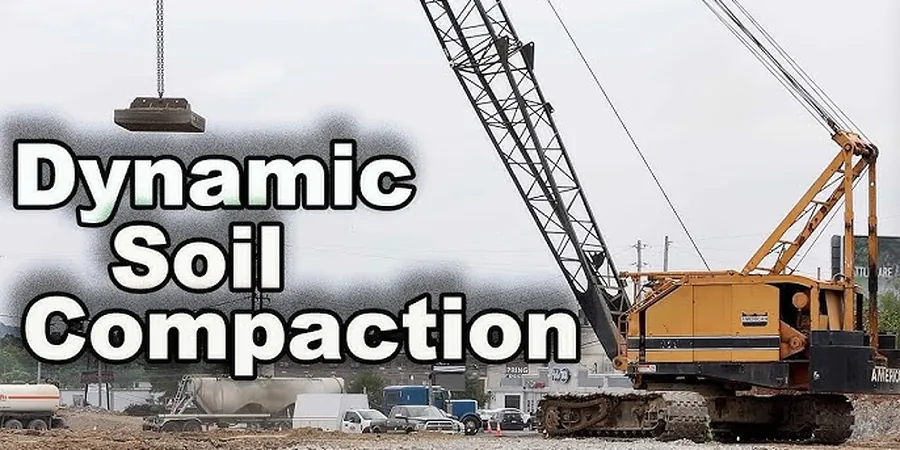
For coastal fills and reclaimed land, high-energy impact is often the fastest path to a competent bearing stratum without deep foundations.
Methodology and scope
- Tamper weight: 15 to 40 tonnes
- Drop height: 10 to 25 meters
- Grid spacing: 4 to 8 meters depending on target depth
- Number of passes: 2 to 4, with intermediate proof rolling
Local considerations
The subtropical climate of Gold Coast means high water tables and frequent heavy rainfall, which can turn a well-designed dynamic compaction program into a mud wrestling match. Saturated sands lose their ability to densify under impact because pore water cannot dissipate fast enough. That is why we schedule compaction campaigns during the dry season and install temporary drainage trenches to lower the phreatic surface. Another risk is vibration damage to adjacent structures. In built-up suburbs like Surfers Paradise or Broadbeach, we monitor peak particle velocity with seismographs and limit drop energy near sensitive buildings. Ignoring these constraints leads to undercompacted zones and future claims.
Explanatory video
Applicable standards
AS 1726-2017 Geotechnical site investigations, AS 4678-2002 Earth retaining structures, FHWA-HI-97-013 Dynamic compaction guidelines, AS 1289.6.3.1 Standard test for SPT
Associated technical services
Site Assessment & Stratigraphy Mapping
We drill boreholes and run geophysics to define the depth of loose fill, the groundwater level, and the location of competent bearing strata. This data feeds directly into the energy calculation for dynamic compaction design.
Compaction Verification Testing
After each pass, we perform cone penetration tests (CPT) and plate load tests to measure stiffness gain and confirm that the target density has been achieved across the entire grid.
Vibration Monitoring & Compliance
We install seismographs at property boundaries to record peak particle velocity during drops. Real-time alerts allow the operator to adjust energy per drop and stay within local council limits.
Typical parameters
Frequently asked questions
What depth range can dynamic compaction effectively treat in Gold Coast soils?
In the sandy and silty profiles typical of Gold Coast, dynamic compaction design can achieve effective densification down to 8-12 meters with a 30-tonne tamper dropped from 20 meters. Heavier tampers or higher drops can extend this range, but the energy must be calibrated to avoid overcompaction of the upper layer.
How much does dynamic compaction design cost for a typical Gold Coast project?
For a medium-sized site of around 5,000 m², the design and supervision phase typically ranges between AU$2,070 and AU$6,260. This includes the initial site investigation, energy calibration, proof rolling, and verification testing. The final quote depends on target depth, grid size, and the number of compaction passes.
Can dynamic compaction be used on sites with high groundwater in Gold Coast?
Yes, but the water table must be temporarily lowered using perimeter drainage or wellpoints. Saturated sands do not densify efficiently under impact because the excess pore pressure cannot dissipate. Our design includes a dewatering plan and specifies a minimum 2-meter freeboard between the water table and the base of the compaction zone.